Saturday, April 29, 2006

Cojones Grande

“Is this how you want to be remembered?” the father asks Yuri Orlov in Lord of War.

Yuri shakes his head. “I don’t want to be remembered at all,” Yuri says. “If being remembered means being dead.”

In a Pearls Before Swine comic strip by Stephen Pastis, the “cute” characters talk about how everybody, in the end, is forgotten. You remember a famous name from a hundred, five hundred, or a thousand years ago. But the more you go back in time, the less people you “remember.”

“Eventually,” the cute character says, “We’re all forgotten, even the best ones among us.”

Somebody said sometime ago, and I’m not sure now if he had something to do with Freud, that it was only the human ego that pushes us to delude ourselves of our sense of importance. Whenever we think of our own personal worth, we tend to exaggerate it. We tend to feel “big.” We tend to see ourselves as if we’re the center of the universe. And indeed, for many centuries before the first breed of upstarts like Galileo Galilei and Giordano Bruno, people everywhere, even ordinary peasants, were sure the universe was made for them. That man was the apex of creation; that there was in fact a “creation.” And that everything else revolved around this blob of mud called “Earth.”
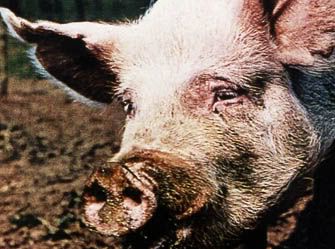
Photobucket - Video and Image Hosting

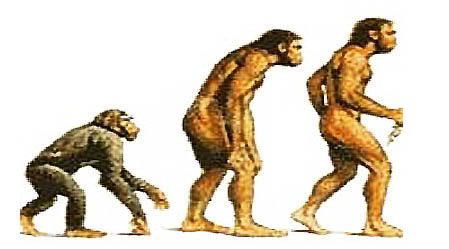
[The big, fat human ego]


These days, somebody like Raul Gonzales would merely roll his eyes and say: “That’s bullshit.”

I might be walking down that road with my devil-may-care swagger, and I‘d meet Raul Gonzales with his needle, ready to pop my bubble.

I might say, “I am a big-shot cyberjock.”

Raul Gonzales would just say: “That sounds like Dinky Soliman’s dung.”

I might say, “You know what, my dick is bigger than Las Pinas City.”

Raul Gonzales would just say: “That’s the stinkiest dog turd I’ve ever smelled.”

Because while Freud’s Ego and Superego would sing in unison about one’s sense of significance, there’s the Id somewhere, lurking in the dark caverns of our heads, always devoted to remind us we’re just animals.

Animals who can talk. And fuck. And brag about it.

One of my favorite scenes in Joseph Heller’s Catch-22 that hits it home so deeply is when Snowden lies on the plane’s floor, the guy’s intestines and lunch slipping out of his blasted torso, and Yossarian staring at it all and finally getting it—finally understanding that man is garbage.

I once told somebody I’m not here to bring beauty to the universe or change this fucking world. I’m not here to make any difference. That was back in those days when people expected wonderful things to come out of my hat, and were disappointed.

I told that same somebody, If you believe that crap, I’ll tell you another. I said, All those kids want to “make a difference.” Now, this planet is a bleeding mess. Everybody you meet down the road, they want to change the world. Now, look at this. Is this the planet you want? A world created by all sorts of crusaders, all sorts of upstarts out to launch their own revolution.

It’s all pap. There are days you’re just tired of it all. You see somebody say on TV, “My dream is to make a difference.” I scratch my head and wonder, how do you do that? The universe is a swirling mass of change, and it churns every moment. How do you add more shit to the status quo, when the status quo itself is a quick-shifting neon light in any Malate trance club?
Photobucket - Video and Image Hosting

Besides, “making a difference” is one of those insufferably crappy lines we love serving ourselves; it’s in the same hackneyed league as “be yourself” or “the greatest good for the greatest number.” Lines nobody really thinks over, lines that we use as ready resource when the need to masturbate strikes or when there’s the sudden craving to slake off some deep personal emptiness.

Human beings are funny. First, they acquire some new evolutionary equipment like the cerebral cortex, and they begin “thinking” that everything they see is made for them. Then, they build on the tale and reinforce it for generations until they begin taking the myth as “truth.” Until nobody remembers that the first guy who told it wove it around a bonfire just to entertain the tribe's kids. Until nobody remembers we’re just articulate animals, after all.

It’s usually fun to listen to the mass of people. But eventually, the fun wears thin. Sometimes, I feel like I'd rather just sit down and stare at my balls till kingdom come.

***
For other Bullshit Meister posts, see:

Wrongness

League of Monsters

Friday Evening Kitsch

The State of the Art

Goodbye, and Thanks for all the Crap


Add to Technorati Favorites!

Wednesday, April 26, 2006

Extra-territorial Pissings

There are only two things I hate waking up to. One is discovering I’ve no coffee left. The other is receiving an “official” email telling me my blog has just been blasted into deep space through some fancy-sounding dish antenna.


That just got my goat. To be fair, when I signed up, I really had wanted to “reach out” to somebody in the star Vega, which was what inspired the writing of the post, “Jesus Sings Sinatra.” It was my way of saying, “We have here some fellow who walked on water; now, it’s your turn. Tell me your planet’s joke.”

That was done in the spirit of intergalactic camaraderie, because I had this feeling in my guts that aliens are no different from people like Scott Adams’s Evil HR Director or folks who suddenly appear in your cubicle muttering the line, “Your base are belong to us!”

But in the intervening time, I realize I might have written something that might make alien life forms unhappy. How would they feel, for example, when they read about my War Against Small Animals? What if aliens were just guinea pigs with laser pistols, and they see my recipe for guinea pig cake? I’m also pretty sure they’d take offense with the way I projected Abner Mercado’s importance in the future of human language (assuming that Abner, in fact, had been spawned in the raging eye of the birthing of Andromeda; hence, the exoskeleton, err, I mean, the ethnic get-up).

Photobucket - Video and Image Hosting

So, to make up for it, I’ve drafted a little haiku as some sort of “I come in peace” line for the aliens who’ll be reading this blog.

[official intergalactic haiku]

If the moon is cheese
And your planet is my butt hole
I’ll poke you, I’ll poke you, I’ll poke you!

Brilliant, isn’t it? My haiku’s so subtle it’s not very obvious that I’m apologizing. I guess that’s just the rare beauty of “alien-speak.”

***
For similar posts, see BullShit Meister.


Add to Technorati Favorites!


Monday, April 24, 2006

Platoon

“The first rule of the platoon is you don’t ask questions about rules.”

Photobucket - Video and Image Hosting


This was not a scene in Fight Club, and I wasn’t Tyler Durden. This was summer of 1987, and I was speaking to a bunch of kids younger than myself. It was already months after I saw Oliver Stone’s Platoon, and I couldn’t still get over the idea of people following orders. It was fascinating. It fascinated me that adults with supposed wisdom in their heads could obey somebody’s stupidest command to the death. So this afternoon, in our front yard, I gathered all my neighbors’ kids—the youngest five, the oldest probably eight—to “consummate” my newly found enthusiasm.

“And our mission,” I said, as I stared at their faces one by one, trying to simulate as much Willem Dafoe military gravitas as possible, “is we’re going to hunt.”

“What are we going to hunt, sir?” one of them asked.

“We’re going to hunt… Hmmmm…” I stopped for a moment; I was mentally choosing between hunting small animals and harassing much younger kids that we could always find playing with paper dolls somewhere. It was a windy afternoon, and the undulating rice stalks in the fields just beyond our picket fence added up to my excitement. These kids were putty in my hands.

“We’re going to hunt snails.”

Photobucket - Video and Image Hosting
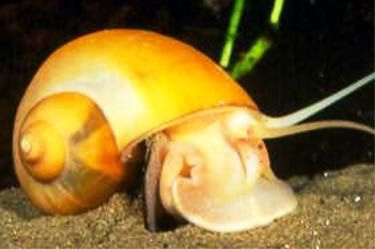
[The golden apple snail]


When they’re still not moving, I screamed, “Now!” They ran in all directions.

There was no greater fun than “hunting” golden snails. Even in the present, the Philippines’ rice fields are still crawling with them; they’re one of those botched agricultural projects that remind you of a doomsday movie, or the creation of chlorofluorocarbons, or Adolf Hitler—things that seemed a solution at first, but later wreaked more havoc than a blonde bitch could do in a room full of horny men. I think the snails were supposedly imported to augment the local food supply, but instead they turned out to be such pests, like today’s janitor fishes. They devour rice seedlings that in some estimates, farmers lose up to 40% of their crops to the snails.

In the 1980s, when my family still lived just a leap away from some hectares of rice paddies, the snails were good “toys”; whenever I was bored and when mother wasn’t looking, I’d take off my rubber slippers and wade through the mud to collect them. Then I’d dump a pail of these snails in our yard and I’d sit back and watch how they’d try to escape from me, their “monster.” Then as coup de grace, I’d stomp on them like what Godzilla did with the citizens of Tokyo. Crushed, the snails were a “hot snack” for free-ranging chickens and ducks that roamed the neighborhood. So it’s probably fair to say that on any given afternoon in those days, everybody, except the farmers, was happy with the snails.

When my platoon came back, each of them had a handful of snails. Their loyalty and efficiency made me smile. I ran to our grocery store, took a small bottle of cooking oil and some empty tin cans and candles, then I told them to follow me to the back yard.

“In single file,” I barked. “And don’t forget to march.”

They giggled and marched behind me.

“This is survival training,” I was saying as I lit the candles and poured some cooking oil into each of the cans. “We’re lost in the jungle, boys. And we have nothing to eat. Thank Jesus Christ we have these snails.”

The “brilliant mission” was elegantly simple: Fry the snails in tin cans, using candles as our stoves.

“At my signal,” I said, “when the oil is hot enough, drop your favorite snail into your can.”

They were all grinning as they held the cans over their candles. When the oil began to smoke, I gave the signal to “unleash hell.” The snails smelled like a revolting combination of black mud and fish, but I stifled my disgust and said, “Yummy!”

The kids chimed, “Yummy!”

And through it all, I never forgot pretending I was Willem Dafoe.

Then when the snails looked dead and fried enough, I ordered them to scoop up the snails and place them on the “ceremonial leaf.”

“What’s a ceremonial leaf, sir?”

“Any broad leaf is a ceremonial leaf,” I snapped.

“Why do we need a ceremonial leaf, sir?”

“Because the platoon will use no ordinary dining plates. Because the platoon will always use Nature as its tool. Understand?”

They looked around, saw a harmless-looking alugbati vine crawling on the fence, and attacked it. In an instant, the vine was as bald as Bembol Roco.

After everybody (except me, of course) had a snail-on-a-leaf “survival meal,” I simply told them to eat it. They all hesitated. One of them asked “Why aren’t you eating a snail, sir?”

I glared at the upstart. “Of course, not. I’m the captain. Captains don’t eat the snails of the platoon.”

They said nothing. So I said, I’m opening a bottle of Coke as soon as they’ve eaten the “survival meal.”

Photobucket - Video and Image Hosting

What followed was something that reminded you of a bukkake session: suddenly, upon hearing the “reward,” they were outdoing one another in trying to make a disgusting thing look delectable. But the moment they finished the snails, my mother called out and I promptly forgot about the promised Coke.

That night, I heard a commotion outside our grocery store. I peered through our window’s slats and saw my platoon’s mothers, all cackling like a flock of geese about their kids’ inexplicable gut-rot. I felt that they already knew it; I was sure all the kids had already ratted on their “beloved captain.” But because we owned the only well-stocked store in the neighborhood, on which the housewives depended so much whenever making ends meet was as difficult as diarrhea, nobody had the nerve to say to my mother’s face everybody’s suspicion.

I was frightened; I ran to my room, glared at the mirror, and told my reflection, “If they all die, you’re dead, too.”

I didn’t dare venturing out of our house that weekend. I didn’t want my platoon or their mothers meeting me on the road and finding my face so full of guilt. I was busy, anyway—I had recently discovered my father’s stash of porn, and I was consumed with the suspicion that our house harbored unimagined treasures I had yet to discover. So I was digging up dusty corners and suspicious-looking boxes in my feverish search for more skin.

One afternoon in the week that followed, I found the kids again playing with toy cars in the dirt. They wouldn’t even look at me. When it dawned on me that I had become some sort of pariah, I ran back to the house, sneaked into the store, and took a handful of colorful hard candies.

I ran out and declared: “Who wants candies?”

All faces turned to me, but everyone stood their ground.

“Alright, you can have these. But we have a new mission, boys. Those who want to join me, raise their hands.”

Everybody raised hands.

I stared at them all, my eyes gleaming in sinister delight.

It was the first time I discovered a shining truth: People never learn. You could always slaughter more innocents.

***
For similar posts, see Backtracks and Fast-forwards.


Add to Technorati Favorites!


Friday, April 21, 2006

Feeding the Cat

Once, when I was six, we had a well from which our poor neighbors would get their water. The well’s water was deep and crystal clear. It so happened that our well for that day was full of fishes. There had been a flood, and when it subsided, the fishes remained trapped in it.

Once, we had a cat that my mother called “Cathy.” One day, Cathy was hungry.

So I asked the cat, are you hungry?

The cat said, “Meow!”

I nodded; that probably meant yes.

So I asked the cat, “Do you want to eat now?”

The cat said, “Meow!”

I nodded; that probably meant yes, too.

So I asked the cat, “Do you want to eat fish?

The cat said, “Meow! Meow!”

I nodded sagaciously; that probably meant, Yes! Yes!

I smiled at the cat; and patted her furry head.

Then I shoved the cat into the well.

I heard a deep splash.

She shrieked, “Meowrrr!”

I assumed it meant, “Thanks!” So I shouted into the well, “You’re welcome!”

I’m not sure if Cathy enjoyed the fish; I never saw her again.


Photobucket - Video and Image Hosting


***
For similar posts, see Essential Cruelties.


Add to Technorati Favorites!


Tuesday, April 18, 2006

Clenched Fist

When I was in fourth grade, I was a small, weak kid. I was the sort who looked like I was begging to be tied to a post and fed to ants. One look at me, and you’d know here’s a kid you could kick without fear of reprisal.

There was indeed somebody who was bigger than me who loved kicking my balls. I hated it, but because I was a newbie in that school and was not very confident about anything yet, all I did was grin or avoid large crowds as much as possible. But this particular boy so persistently hounded me until I came to the end of my tether; he was bigger, taller, and generally looked like he came from Hell. He’d make faces, interrupt my conversations about the amazing powers of Voltron and the Transformers, and eat my food. Worse, he had the entire class behind him; he was the kind of boy whom the teachers loved because he sucked up to them, and usually, when he’d fuck up, he’d cleverly pass the blame to somebody else—and that somebody else, at that time, was often me.

So there was a point I decided that, although I’d usually avoid physical trouble, maybe I should make an exception. Maybe I should give this boy a taste of his own blood.

One day, somebody sold me a metal ring for fifty centavos. The ring’s supposed diamond was just cheap glass, and when you’d remove the glass, what’s left were the little metal claws that used to hold the stone. It became a terrible little weapon. I would wear the ring in my quiet moments and promise myself the next time the fucker busts my balls, he’ll be sleeping with the fishes.

So one afternoon, I was on my way to school when I spotted him at the far end of the road. I felt the rush of blood to my head. I took out the ring from my backpocket and slipped it into my middle finger. I steeled my nerves and surrendered to the fact that it was probably my last day on earth. It all felt like suicide, like I was running headlong to something that would shatter me so utterly. But I thought, if this fucker makes the mistake of doing something that even remotely resembles oppression, God help me, but I would rip that face apart.

Then I clenched my fist, shoved it deep in my pocket, and walked on.

But for some reason, the boy disappeared; he probably made a turn that I didn’t see because I was so rapt in my thoughts of “righting what was wrong.”

I failed to see him at school that day. More strange was that, afterwards, he and I would be good friends. Well, not really good good friends, but something along the lines of I-Leave-You-With-Your-Shit-Alone-While-I-Bother-Other-People kind of friendship. I don’t exactly remember how, but I think it started the day he asked me to draw something naughty and I obliged.

Years later, that fellow would die in a freak motorcycle accident.

I would also forget about the ring for some years until one day, when I was about to enter college, I found it again at the bottom of a box that contained the knick-knacks of my childhood. Half-buried in lint, the ring glimmered faintly as old memories sometimes did. I picked it up, held it against the sun. The ring was still sharp; its little claws looked like the talons of a small bird. But it was still sharp. The cutting edge could still make you bleed.


***
For similar posts, see Backtracks and Fast-forwards.


Add to Technorati Favorites!


Sunday, April 16, 2006

Patterns from the Cold

One day in 1963, mathematician Stanislaw Ulam was bored out of his skull at a scientific conference. But instead of screaming “Fire!” or “Vietnam!” and head for the exit to spice things up, he did something only mathematicians would do: he doodled on a blank sheet of paper a spiraling grid of regular numbers—1, 2, 3, 4, 5, and so on. Then he circled all the prime numbers—and what emerged made him scratch his head. The prime numbers form diagonal lines on the grid. It looked like some sort of pattern.

The whole thing is now known as the Ulam Spiral, which even today, nobody has yet fully explained.

Image hosting by Photobucket

Often, what strikes humanity into humble submission are the staggering surprises.

Take the circle, for example. Any circle seems so simple; take one look, and it seems clear a circle will be unable to hide anything. It’s just some naked shape. But once you succumb to the seduction of attempting to look at the ratio of a circle’s circumference to its diameter, you’re like opening Pandora’s box: you’re met with the maddening complexity of the pi's endless string of numbers—3.14 off into infinity.

The numbers jump out of the box to bury you under its staggering endlessness.

These mysteries help you understand why mathematicians talk about numbers as if the subject of conversation were the curves of Eva Longoria or Naomi Watts. Mention something like Fermat's last theorem to somebody like Carl Friedrich Gauss, and the guy would probably have a hard-on. Whisper the Poincare conjecture to Grigori Perelman, and he would probably wet his pants and wax nostalgic. Math is so seductive because, for one thing, it’s like everybody’s Lady in Red—she’s this beauty that seems to be both “easy” and hard to get, both so happily understandable and so deeply confounding. And that’s just the stuff undying romances are made of.

But sometimes, math can be a bitch.

That line was on my mind a decade ago when I had the epiphany I loved calling “The Day the Truth Fucked Me.”

The said epiphany basically says: “Goddamit. I am not a math person.”

This was after I had successfully convinced my father to buy me my first personal desktop computer. This was after I had bought all those pricey math textbook references that were supposed to do to me what spinach did to Popeye: Make me tough and “muscled” enough to face and grapple with algebraic confusions.

I was in my third year as an engineering student. I was on my study table, a three-inch-thick physics textbook parted before me, when the epiphany hit me. I could even tell you what went through my head at the exact moment on that day in 1995; I could tell you how the newly-bought book’s pages smelled, and which cassette tape I was playing in the deck (U2’s Zooropa). But none of these small things matters, really. What matters was that I was quitting; that the following day, I would be dropping all my math subjects. What matters was that finally, I was admitting I was a technical loser, after all. That I would never have Bohr's insight, or Newton's precociousness.

But despite admitting defeat, I continued standing outside the fence of the happy party, refusing to just turn my back on it all and walk away; I would avidly consume anything if it had something to do with folks like Stephen Hawking or Richard Feynman or when there’s news about the planned terraforming on Mars. I would pounce on every copy of Discover or Wired, and because those were days I lived on a measly allowance, I would kid my friends that I was devising a scheme on how to steal more copies of these magazines from a nearby bookstore—and usually, nobody would notice I was in fact serious.

Image hosting by Photobucket
My “failure” has been responsible in making me an obsessive bystander, “watching” Sagan or Dawkins do all the work while I root for them halfway around the world, in my room deep in the bowels of the Third World.

But sometimes, I wonder how it might be if I were some math whiz like Maximillian Cohen in Darren Aronofsky’s 1998 film, Pi. The main character is a social outsider who believes everything in nature can be understood through numbers. Max is obsessed with patterns.

Image hosting by Photobucket
[A sample of the Ulam Spiral]


Although widely criticized for its flawed and muddled Kabbalah and Western math, the film is intriguing enough because of the questions it poses. There’s the layer of meaning that says the universe’s fabric, from the very large to the very small, can be plotted with numbers; step back far enough—like what Ulam did with the grid of prime numbers—and you might see a pattern. The name of God, maybe. The future of the stock market. Or just the little cherished answer to your most personal question.

Sure, you can’t take these things at face value. Especially because each question mankind manages to answer only gives birth to another set of questions previously unimagined. But that’s the beauty of it, isn’t it? Because it shows us that there will always be some more “staggering surprises” left lying around in the universe, promising us that we’ll never run out of wonder, telling us that humankind will probably never stop running on the eternal treadmill.

These surprises are just waiting for the next fool, waiting for the next wunderkind to find them.


***
For similar posts, see Random Acts of Strangeness.


Add to Technorati Favorites!

Monday, April 10, 2006

V for Vindication

Talking about Judas Iscariot is like talking about porn; he belongs to that hated class of things called “Which We Do Not Speak Of.”

But thanks to National Geographic, here comes Judas’s Gospel, which seems to do to Judas what Hugh Hefner did to the porn industry—make the whole thing soft enough for the masses.


Image hosting by Photobucket


The first thing that hit my head on hearing about the Gospel of Judas was Martin Scorsese.

You see, Scorsese—Martin to his friends and probably Il Capo Di Tutti Capi to some influential Italians who must love him—made the film version of Nikos Kazantzakis’s novel, The Last Temptation in 1988. The film pissed off Pope John Paul II so much that the Pope went to Martin Scorsese's home, spat in the director's face, and muttered the famous line: "You know what, Martin, I kinda liked Taxi Driver. But this... But this... This is just full of shit."

Okay, I’m just kidding about that one. What really happened was that after the release of the highly controversial film, Cardinals Fang, Ximinez, and Biggles, and a dozen of those other guys who had happily burned folks like Giordano Bruno and Joan of Arc dragged Scorsese to Rome, gagged his tongue, stripped him naked, and burned him at the stake, with Scorsese reported to have screamed: “Robert de Niro will avenge me! He’ll kick your pampered Catholic arses…till you beg for your MOTHERS!”

All right, I’ll be serious now.

In both the 1955 novel and in the film, Judas is not really “bad;” in fact, he’s not only rational, revolutionary, and sensitive, but he’s also smart and principled—he’s a better specimen of humanity than the rest of the disciples who are nothing but a bunch of superstitious yes men.

Judas questions everything, and he has a firm belief in the ability of Jesus to emancipate the Jews that he acts as Jesus’ bodyguard and is usually the first to present logical strategies. Judas is convinced that Jesus’ future is in politics—that ultimately, Jesus will free all Jews from the Romans. But Jesus realizes later that his purpose on Earth is to be the “lamb of God,” which means sacrificing himself on the cross.

In one of the most unforgettable scenes in Scorsese’s film, Jesus urges Judas to betray him to accomplish the “divine mission,” but Judas gets annoyed with the “change of plan.”

“Die?” Judas asks. “You mean, you’re not the Messiah?”

Jesus says, “I am.”

“That can’t be. If you’re the Messiah, why do you have to die?”

“Listen,” Jesus says, “At first, I didn’t understand myself…”

“No, you listen,” Judas cuts him. “Every day, you have a different plan. First it's love, then the ax, and now you have to die. What good could that do?”

“God only talks to me a little at a time and tells me as much as I need to know,” Jesus says.

“We need you alive!”

“Now I finally understand!” Jesus says. “All my life—all my life, I've been followed by voices, by footsteps, by shadows. And do you know what that shadow is? The cross. I have to die on the cross, and I have to die willingly. We have to go back to the temple.”

“And after you die on the cross, what happens then?” Judas asks.

“I come back to judge the living and the dead.”


I have loved that film for years; it cemented my admiration for Scorsese and made me discover Kazantzakis and his works. As noted by critic David Ehrenstein, the film presents “divinity not as a given, but rather as a process Christ explores through his humanity.”

And personally, maybe it meant more to me because when Jesus blames himself that Mary Magdalene has become a prostitute when he could have married her, his sadness, his confusion is so excruciating that the physical pain later on the cross seems like a joke—it showed me how this is a Jesus I can feel, I can believe, I can sympathize with—and this is me speaking as an atheist.

And now, this Gospel, which somehow has the same role for Judas as conceived by Kazantzakis—or is it the other way around? I’m not really sure if Kazantzakis ever had any idea about the Gospel of Judas and its general drift. By many accounts, Kazantzakis was a spiritually restless thinker; he didn’t take comfort in the canned answers of his religion. He explored with his fiction. He hit on things. And he probably read about St. Irenaeus and got the idea.

But the point is, the Gospel of Judas somehow reaffirms what some of us have suspected: that the whole thing about the betrayal as told in the official canon of the four Gospels somehow lacked what Wendy Wasserstein would call “the third punch.” Yes, that kind of betrayal is believable; human history is full of that shit, from Julius Caesar’s “Et tu, Brute?” to Evander Holyfield’s “Fuck, Mike, did you just bite off my ear? I thought we were…friends?” But somehow, it has always felt lacking of something.

Let’s pretend I believe in the Passion; let’s pretend I’m buying it at all. Now, in my book, there’s something so unexciting about how the end came for somebody like Jesus; the whole thing has always felt like a soap opera, where the villains and the heroes are as clearly cut as cardboards. If you’d ask me, and if I may tell you frankly, there are no “human beings” in the four Gospels; what we find and what we read are caricatures, stick figures, bleeding puppets. But now, with the Gospel of Judas, or with stories like that of Kazantzakis, we’re offered an alternative, “more believable” story that even nonbelievers like me are seduced to like it.

I wonder how it’s going to go down the road. How the entire orthodox world would nibble on this thing. Anyhow, if Kazantzakis were here today, he’d probably write a sequel to The Last Temptation. He might give it the title, Judas and the She-Goats. Or Judas: The Disciple Who Shagged Me.

But I don’t know; that’s just a wild guess.

***
For similar posts, see Random Acts of Strangeness.


Add to Technorati Favorites!


Friday, April 07, 2006

Gab @ the Speed of Light

There was this friend who was so excited over something that he appeared in my house one night and began shooting off with the mouth.

He said, “It’s so fucking cool, you could shit in that fuck, and I’m like so fucked out, man. It’s fucking terrific, you could shit in that fucking stupid fuck!”

I stared at him for long minutes and the only thing I remember saying was, “What’s that again?”

It wasn’t really a question; I was stunned realizing he was trying to tell me a tale and he was using less than a dozen words.

Quite recently, I’ve been learning to speak Cantonese, and it astonished me that when you speak a language like Cantonese, you better be careful with your intonation. “Sing” a word with the wrong tone, and you might as well be saying a completely different word—and in certain exciting parts of China, that might mean getting beheaded or getting laid.

What if in the future, for example, the word “fuck” can mean five hundred different things, depending on how you “sing” it. Or depending on when you say it, where you say it, how you say it, what color of underwear you’re wearing when you’re saying it, and where your hand is located while you’re saying it.

Maybe in the future, the only words that will stay will be those that are necessary to explain life; words like “fuck,” “shit,” “cunt,” “dick,” “boobs,” and “Abner Mercado,” for example.

Maybe folks like George Bush, Gloria Macapagal-Arroyo, or Debbie Lafave might have a chance entering the hallowed ranks of my less-than-a-dozen-word “envisioned” language, but I’m not really sure.

Maybe the human race will end up twisting a single word to mean many different things.

Take “Abner Mercado”:

You’re such an abner mercadochist! I hate you!

Don’t you be abner mercadoing my fucking leg, because I know.

Look at that guy, he’s abner mercadoing on the fucking pole. Look! Ha ha ha!

Frankly, my dear, I don’t abner mercado a damn.

Don’t abner mercado with Texas!

We are quite sure Iraq is bristling with abner mercados of mass destruction.

Flush the abner mercado, will you?


What can be more delectable than Magnolia's abner mercado-flavored ice cream?

When you think about it, human language is getting increasingly streamlined. As technology continues to create faster, more efficient, deeply indispensable machines, these same machines drag us around like those nasty kids did in Children of the Corn and force us to live as fast, as efficient, as “compressed” as they are.

LOLs.

The other day, I caught a glimpse of Pride and Prejudice, a film based on a novel set some two hundred years ago, and it awed me how this guy would take ten million pages of script when all he wants to say to Keira Knightley is that he’s got the hots for her.

While in the Middle Ages, somebody like Chaucer would take a long and winding road to tell some erotic tale like that of the merchant, somebody like the Black-Eyed Peas these days would just merely say, “What you gon' do wit all that breast? All that breast inside that shirt?”

Or in the terse, intense style of my over-excited friend, the entire Pride and Prejudice or Canterbury Tales would be summed up in the over-exciting words:


“It's fucking terrific, you could shit in that fucking stupid fuck, man!”


To take this to an even more unthinkable extreme, maybe in the future, human language would end up having only two words.

Two words might be enough to describe life, the universe, and everything.

I wonder what those two words might be.

***
For similar posts, see Bullshit Meister.


Add to Technorati Favorites!

Sunday, April 02, 2006

Strange Brew

I’ve invented something that could instantly kill living things. And I’m only eight.

Image hosting by Photobucket


It’s amazing, I tell my friend. He gapes at what I’m handing him.

His runny nose has already made a permanent yellow-greenish pair of mucus canals from his nostrils to his mouth, and there are times I wonder how it must taste.

It instantly killed that plant, I say.

I point at the plant, which is all wilted under the sun. It really looks very dead.

We can conquer the world with this, my friend says, in his hand is the bottle of the brew I’ve “invented.”

This is 1984. I’m in second grade. We stand in the sweltering afternoon heat of the school yard of Bacoor Parish School. I just made my first “invention”: a bottle of a strange reddish liquid, a mere drop of which could kill an otherwise healthy plant.

Now, how did I invent such a potent thing, in the first place?

We owned a small grocery store in 1984, and one day, I found a small box brimming with all sorts of medicines past their expiration date. There were blister packs of red and green pills, white tablets, frothing cough syrups. The moment I saw the cache, my eyes gleamed with delight; I had just seen a movie where there was this scientist with all sorts of colored liquids in tubes, and he did some very cool things like shrinking somebody to be small enough to swim into a woman’s vagina (years later, I would see something similar in Pedro Almodovar’s Talk to Her).

The scientist in that movie impressed me so much that afterwards, whenever the adults would ask me the Shakespearean question, “What do you want to be when you grow up?” I’d say, I want to be a professor or a scientist, never mind that I didn’t really know what kind of teeth-gnashing those vocations involved.

I wouldn’t usually blink when I'd say that. It became an all-consuming ambition, although later, I’d change my mind over it many times. Of course, in the present, I’m far from being a scientist, but I’ll talk about that kind of shit maybe in another post.

There was this one time we were in a jeepney, and my mother’s friend asked me that same question. You have to realize that I loved being asked that question; deep inside it made me feel good just giving my answer. As if just giving the answer already made it real and true, like some sort of self-fulfilling mantra.

So I gave the stock answer; and I was so caught up in my reverie that I didn’t realize my hand was already resting on the knee of the girl beside me. I realized it only when the adults around me were chuckling and staring at me as if they’d seen a pervert. It was a good thing that the girl, some hottie in her teens, merely found it amusing that some eight-year-old would find her knee attractive enough to be “lost” in it.

But back to my invention. This strange brew, I created it out of some white tablets, multicolored capsules, and some bottles of cough syrup mixed together. Before I showed this to my friend, I had tested it first on my mother’s cat. Well, the cat survived for some reason (she had nine lives, anyway), although she limped away while giving me what seemed like the feline version of a “scornful look.” But I took it as sufficient proof; I interpreted it as my brew’s potency. I went to school that afternoon with a bottle full of that strange brew. In my heart, all eight years of me, I had already “arrived”; I was already a frigging “scientist.” Dang!

The first thing I did when I arrived at school was look for some unfortunate test subject. And because there were no cats at school, and because I was afraid that if the cat died, it would be hard to conceal the evidence, what I did was sneak into the schoolyard, choose some scraggy bush that nobody cared about, then poured some of my brew on the poor thing.

And to my horror and amazement, the plant wilted before my very eyes.

I was ecstatic; I ran back to the room crazy with the thought of world domination.

And so, my classmate with the perennial runny nose, gazes now at my bottle, then asks, “Which plant did you say you poured this on?”

I point at the plant in the corner.

His face follows my hand. He stares at the plant long and hard.

That?” he says. “That’s the plant you killed?”

Yeah, I say.

“But that’s not dead. That’s a makahiya*.”

I just stand there, not comprehending it. He walks over to the plants and begins touching each one of them, and each one, after being touched, “wilts” so dramatically. I’m stunned. I feel so foolish, but I hide and swallow my embarrassment. I’ll never admit to this kid that I now know how stupid I am.

Oh my God, I say, you have magical powers? You can kill them with your touch?

I flash him my best shit-eating grin.

He gives me a look that years later I would learn to mean “fuck off.”

Then he walks away, my dirty, impressionable friend.

*****
Makahiya’s scientific name is Mimosa pudica. This plant “wilts” when touched, the compound leaves fold inward and droop, re-opening within minutes. Its ability to “move” has fathered the self-awareness of countless kids with delusions of grandeur.

***
For similar posts, see Backtracks and Fast-forwards.


Thursday, March 30, 2006

Judas the Armadillo

I think this is how “the betrayal” actually happened.

Image hosting by Photobucket

[Judas to Jesus: I’m forming a heavy metal band. I’ll let you do drums. Come on, what do you say? I’m not really gay, but I’m so sincere I’m kissing you.]


When evening came, and when Saturday Night Live was over, Jesus was reclining at the table with the Twelve. They talked about why Scarlett Johansson was simply the sexiest girl on Earth, and how George Bush sometimes reminded James of a nasty baboon he once saw on National Geographic.

And while they were eating, Jesus said, "I tell you the truth, one of you will betray me."

They were very sad and began to say to him one after the other, "Surely not I, Lord?"

Jesus replied, "The one who will dip his hand into the bowl with me will betray me.”

At that time, Judas was not listening; he was so busy prying off his dentures that got stuck in the ham that he was startled when he dipped his hand into the bowl and felt that somebody’s hand was also there.

It was Jesus’ hand.

Jesus and Judas looked at each other.

And Judas said, “Is it I, my Lord?”

“Is it I my Lord?” Jesus said, mimicking Judas. “Is it I, my Lord?”

“But that was an accident,” Judas stammered. “I didn’t hear you.”

All the disciples stared at Judas.

“So now I am the villain, eh?” Judas said. “So what if my opinion has always been different from yours? Look, guys, if we’re gonna say the same thing, why in hell do we have to speak at all? Why don’t we just stare at one another and admire one another’s butts?”

James said, “Dude, you can’t do that to the Son of Man.”

“Yeah,” John seconded. “I thought only Dinky Soliman could do that. And now, we have you. Now, God will punish you and transform you into a Chinese spotted swine.”

But Judas didn’t become a Chinese spotted swine; in an instant, he transformed into an armadillo.

The other disciples were so astonished.

Bartholomew said, “Cool.”

James said, “I’m sick and tired of eating bread my whole life. Don’t you guys think this thing will taste good when roasted?”

“Yeah,” James said, “let’s stick it up on a spit and roast it over the coals. Like what folks do in the Philippines.”

“Do they have armadillos in the Philippines?” Bartholomew asked.

“No, but they have Franklin Drilon and Joe de Venecia. I think that’s worse.”

But as they spoke, Judas the armadillo rolled up into a ball and went crashing out the door. He rolled and rolled until he found himself in the temple. Once in the temple, he became a dude again.

Judas ran to the first priest he saw and screamed like a girl.

And the priest asked, “And who did you say tried to eat you?”

“Jesus Christ!”

“Aw, come on. Try another one.”

“No, I’m serious. Jesus and my friends tried to eat me. They thought I was an armadillo.”

The priest laughed. “Yeah, I watched this Monty Python film once. They had this Roman general named Biggus Dickus. That was funny, too.”

“No, no, no!” Judas panicked. “I’m telling the truth. Look, if you don’t believe me, I’ll lead you to them. They’re going to a beer garden called Gethsemane.”

“And?”

“And I’ll kiss the one who tried to eat me.”

“And why would you do that?”

Judas was stumped. “I don’t know. Maybe it’s written somewhere that I should kiss him.”

“Okay. I have this feeling this information is not free, is it?”

Judas stared at the priest, his eyes gleaming. He said with a Dr Evil gleam in his eyes, “You have to pay me thirty. Billion. Fifillion. Zizillion. Silver. Pieces.”

The priest laughed. “Are you crazy? Guards, get this piece of shit out of here before I have him guillotined.”

“But, Sir,” Judas said, “the guillotine hasn’t yet been invented.”

“Okay. What’s your point?”

“Well, you can’t guillotine me if nobody yet knows what a guillotine is.”

The priest pondered it and said, “Tell me about the electric chair.”

“Sure, sure,” Judas said impatiently. “But pay me first.”

Again, the priest laughed.

“Five billion,” Judas said.

The priest shook his head.

“One billion?” Judas said.

The priest was rolling on the floor in laughter. One of the guards said, “This guy’s so hilarious. He’s even funnier than Teddy Casino and his friends hiding inside the Batasan Complex.”

“Yeah,” another guard said. “or that bunch of buffoons who call themselves the Black Friday Movement. Really funny.”

When the laughter dissipated, the priest said, “Dude, we won’t give you any. Not one, not ten billion silver. But….”

“But what?”

“But if you can really kiss this guy like you say you would, I’ll give you something. Maybe a bag of peanuts.”

Judas thought it over, realized it was fair enough, and whispered, “I have a little problem. I’m willing to accept the peanuts, but can we keep it secret? Like don’t tell anybody?”

“Sure,” the priest said.

“And can you mention in your Jewish newsletter that what you gave me were silver coins?”

The priest thought about it, nodded, and said, “You know what, I like you.”

Judas grinned. “I like you, too.”

“I’m not really a full-time priest. I sing and do guitars at a local pub. Maybe we should form a band.”

Judas became excited. “Cool. Let’s call it Judas and Priest.”

The priest said, “Why not Judas Priest?”

“Okay.”

And so Judas left the temple with his bag of peanuts. After the Gethsemane incident, the duo formed a heavy metal band in 1970, and went on to become what junkies call “The Metal Gods.”

Now, that’s funny.

***
For similar posts, see Sacred Cows 2.0.


Add to Technorati Favorites!


Sunday, March 26, 2006

Traipsing in the Dark

Cyberspace is full of dead people; it’s crawling with traces of people’s last thoughts, last sentiments, last human impressions.

In a sense, mankind has unwittingly created an electronic version of immortality.

Image hosting by Photobucket


Simon Ng was a college freshman in New York. In May 2005, somebody tied him up and repeatedly stabbed him in the chest with a butcher knife—but that was minutes after Simon made his very last blog entry.

That blog entry later helped the police trace the murderer.

There’s a quirky side story why I signed up on Friendster in the first place. For some years, I ignored it because I considered it merely a fad for teenagers. But one day in the summer of 2004, a girl was murdered in her own condo unit. The girl was a Metrobank employee, and days after her death, an email circulated that directed people to her Friendster account. I couldn’t resist it; I was on Friendster faster than you can say “Bienvenido Jesus Torres.”

Since then, while I struck “friendships” with total strangers, I realized the heartrending side of Web-based services like blogs and social networks. People remain “alive” on the Web even years after their passing. And often, so few realize it.

Friendster, for example, doesn’t delete an account even if it remains inactive for many, many months. In October 2004, amateur mountaineer Prana Escalante died on Mt. Halcon. Anybody who is curious enough may still see her account and learn how much she loved life and Samurai X.

Sometimes, things are fresh as today’s headlines. There was a woman who was manager of that McDonald’s branch on Taft Avenue beside DLSU, and the last time she accessed her account was hours before her bitter officemate shot her in the head.

Folks with “normal” sensibilities are usually “shocked” when I’d tell them I dredge the Web for traces of people’s lives. But I can’t help it; I’m consumed with the desire to know these people as human beings, not as some goddamn statistic.

Like Johnny Smith in Stephen King’s novel, The Dead Zone, or that kid in M. Night Shyamalan’s Sixth Sense, I see dead people as I caress and romance the dark underbelly of cyberspace. There are times I’d be staring at my monitor for long moments, placing myself under their skin, retracing the last seconds their fingers tapped on those keyboards,

And I wonder and wonder about the meaning of it all.

Technology gives our human presence some sort of “permalink” to the wired and wireless masses in such a way that persists as long as the foundations remain in place. In Sky Captain and the World of Tomorrow, the “evil” genius Totenkopf fools the world for two decades into believing that he’s still alive, when it’s merely his machines that have been continuing his work down to the last details of the man’s disdain of humanity.

And it’s not only about dead people, but also about dead websites. A month ago, I rediscovered the Internet Wayback Machine, and saw again the homepage of a literary site I used to maintain.

I called it The Inkblot, for lack of any better name. And years after it “died,” I discovered for the first time how it was full of crap, and how much somebody like me could change in the past five years.

I often wonder how things run these days. How everybody can have access to somebody else’s most treasured feelings and thoughts that would have mortified the living daylights out of somebody like Beethoven, JD Salinger, or Thomas Pynchon.

And more to the point, how practically anybody can leave persistent vestiges of their lives in cyberspace.

Maybe, in a universe where lives are short and people know they are doomed, and where things end without any sense of resolution, we find ourselves consumed with this desire to leave our mark on things that we touch. We find ourselves in situations that somebody like Kazuo Ishiguro loves fleshing out.

And maybe, like Bjork in Dancer in the Dark, it’s our lot to find ourselves so jaded for having seen it all, but still having the heart to cling on, hold on to the brightness of some little spark—whenever, however, wherever we find it.

****
Simon Ng’s last blog entry on May 12, 2005.

New York Daily News article about the arrest of his murderer.

Latest Dead MySpace members.


***
For similar posts, see Random Acts of Strangeness.


Add to Technorati Favorites!

Friday, March 24, 2006

Trouble with the Debutante

Image hosting by Photobucket

We’ve been deciding on how to create a new invite for a girl’s 18th birthday. The mother of the girl wants something different. While the usual invites say something like, “I’m 18 now, you’re invited” and all that shit, the mother wants it done in as unique a way as possible.

And we’re wracking our brains because all our brilliant ideas are being turned down.

What’s wrong with these title suggestions?

  1. I’m 18... I’m legal now.

  2. I’ve just turned 18, so come and pop my cherry!

  3. I’m 18 and ready for some action. Come join the fun!

The girl’s mother is no fun at all. I don’t see anything wrong with these suggestions, but there she is, angrily stomping around the room like one of those lead characters in Jurassic Park (I’m not talking about the humans).

For example, she’s raising hell about the “cherry” part. What’s wrong with the cherry? It’s going to be a great bash, so it’s fair to assume there would be lots of cakes and fruits, so what’s wrong if I’d assume there would be cherry in a salad somewhere? Sure, it would be okay to replace the fruit with, say, mango or banana, but anything else wouldn’t sound “girlie” enough, would it?

“I’m 18. Come and pop my mango” doesn’t sound so right, does it? Would you go to a party of a girl that says, “Come and pop my mango?” Come on.

Maybe there’s something wrong about it that I just couldn’t put a finger on.

But for the meantime, the mother wants us to suggest something unique about the humongous cake. That gets me so excited, because I’m thinking about suggesting we sedate and bury a dozen small guinea pigs inside the cake. And then at a signal, maybe we’d use something like an electrode, we’d wake up the guinea pigs, and they’d all be crawling out of the cake at the right moment. Their faces would be covered with icing, and they’d be sniffing their way on the table. I’m sure they’d be so cute they would delight the guests.

Darn. I’m so good I can kiss my own ass. I bet the mother will just love it.

Image hosting by Photobucket

[Guinea pigs make for a delightful cake.]


***
For similar posts, see Essential Cruelties.


Add to Technorati Favorites!

Wednesday, March 22, 2006

Kubrick's Apes

The further integration of blogging into the lives of individuals is fast taking us back four million years ago, right at the heart of Stanley Kubrick’s greatest tale.

Image hosting by Photobucket

I have always believed the whole idea behind blogging is simple: placing anybody in a role that allows them to make sense of something as faceless as the Internet on a purely personal level.

I’m seduced to imagine a swarm of humans approaching this giant called the “Interweb,” poking its underbelly with their little stick/schtick, and seeing how it reacts.

If it wakes up, if you get its attention, you have options. You either ride on it and let it take you to places, or you scoot back to your cave.

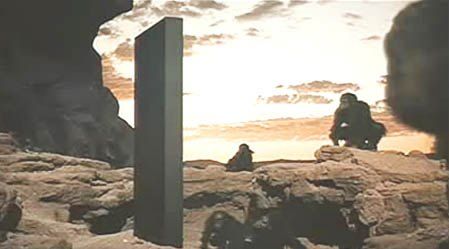
The Internet in its present incarnation has become a truly Grand Monolith, which reminds me of the same block of gray in Stanley Kubrick’s 2001: Space Odyssey. In the film, a mysterious monolith appears amid a sleeping group of apes. The apes, when they wake up, react with the three great things that would later propel their own evolution:

fear, curiosity, and courage.

The monolith becomes a point of contention: they stare at it endlessly, they fight over it, they try so much to make sense of it. It baffles and annoys them. But it also inspires them. The apes make those excited grunts that you could only hear these days from somebody like Elizabeth Ramsey.

And because they cannot deny its existence and they can do nothing about it, the monolith somehow arouses them to develop what could be life’s next best creation since the human cerebral cortex: the human tool.

This part of the film where one of the apes makes a little tool out of animal bone is one I could not forget: because the tool, uncannily, is also the world’s first weapon.

It drives home one of the important points of the film: that the first product of human ingenuity was not the wheel, not religion, but something fashioned to defend and destroy.

Which, when you think about it, is also very much like religion.

The tribe of that ape that invents it, the tribe that had been driven away from their precious water pond, makes a comeback with the weapon to slay the fuckers that had driven them out. And there, in a classic “war over natural resource,” the “advanced” tribe makes its first kill.

Us bloggers are like Kubrick’s apes; we were all sleeping when it hit us in the 1990s. Some of us merely touch it and some rearrange their lives around it. And there are those who spend most of their waking life trying to make it fit into the grand scheme of things, and somehow, make it into a really good thing.

How blogging is fast emerging as a powerful form of media works the same as Kubrick’s prehistoric monolith: we are forced to grapple its possibilities with the things that make us human. Blogging, and the Internet at large, has aroused our fear, our curiosity, and our courage. It has filled us with a certain longing for something that engulfs and devastates—and also empowers.

These days, we blog about the cute puppy or the cat, the daughter’s first smile, the drugs and rock ‘n’ roll. We blog about how we could enlarge our dicks and complain why John Holmes or that guy on Bang Bros had it so good. We blog about how this girl’s boobs are so stunningly gorgeous and so large that they have their own political system. We blog about the cute classmate who never knew our name. We blog about our little triumphs and our little questions.

We wage our wars here, we say our “fuck yous” here. And the good thing, whenever a gaggle of us hit critical mass, the targets of our yearnings eventually listen.

But blogging isn’t only about the things that excite your mother; it has also become a balance of sorts. It has become, to use this blog’s theme, a skirmish of dark and light. Because for every molecular biologist documenting their find, there’s a pondscum somewhere preying on the unwary. For every tech-savvy CEO who reaches out to his company’s direct consumers, there’s an idiot who uses a frightened blindfolded man as his header image (why does this sound so familiar?).

Xanga alone currently hosts fifty million bloggers, and most of them are articulate enough to define both the gaudy, terrific excess of a meaningless life and the unbearable lightness of being. And for better or worse, bloggers are driving decision-making and commerce across the planet.

This emerging monolith has allowed the individual to give face to an otherwise formless giant. And like the apes in that 1968 film, we are sinking deeper and deeper in trying to make sense of it. It has been changing us so quickly. It has been pushing us out of that door.

Until maybe one day, we’ll find ourselves finally out there, in a place we could no longer return from.

***
For similar posts, see Random Acts of Strangeness.